
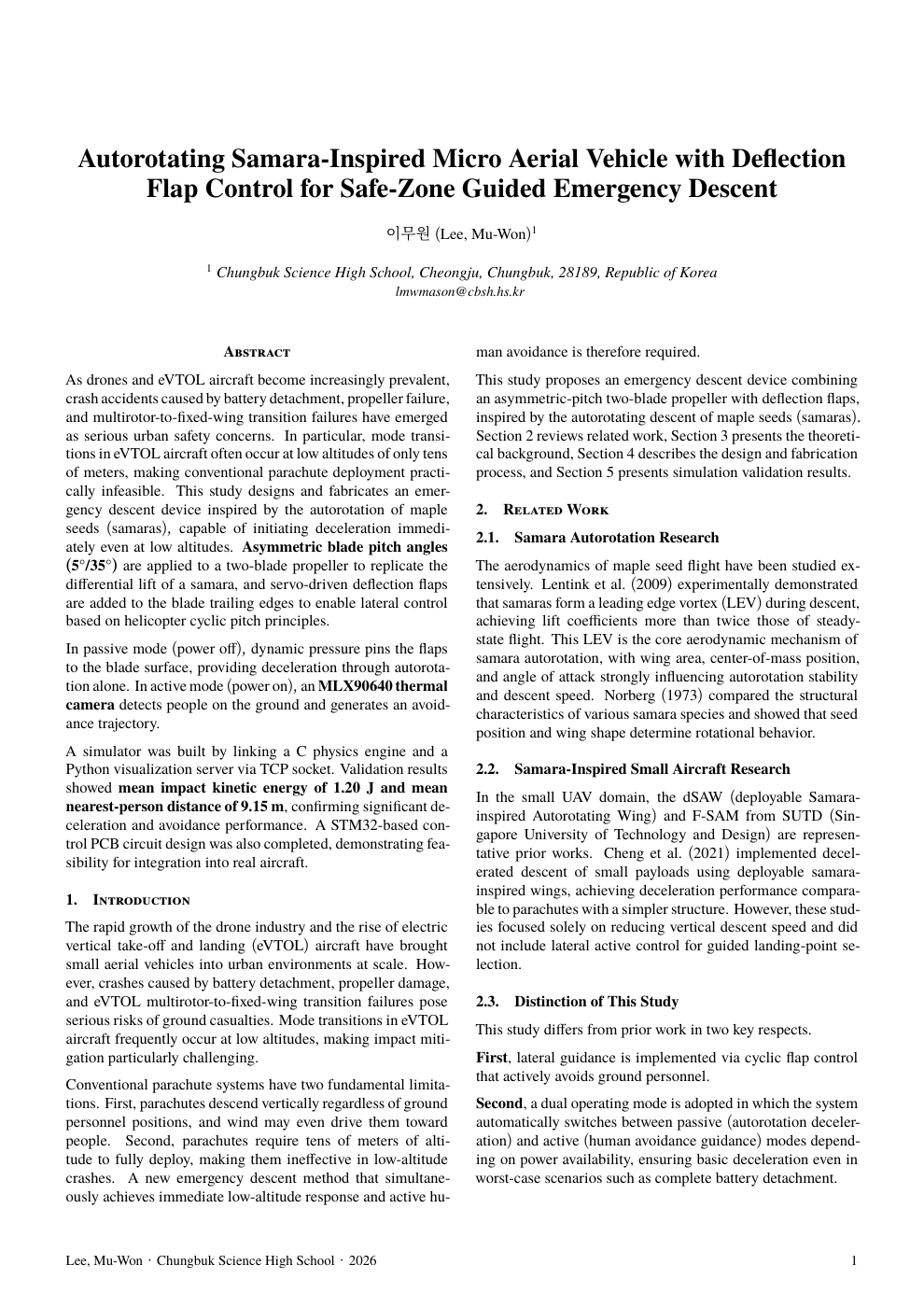
Overview
A samara-inspired emergency descent device combines passive autorotation with powered lateral guidance. The report documents mechanical prototypes, an STM32 control-circuit design, and a C/Python simulation.
Problem definition
At low altitude, an emergency descent system has little time to deploy or decelerate. The design explores immediate autorotation and steering away from modeled ground personnel.
Research motivation
Maple-seed descent motivates asymmetric blade loading. A passive mode provides autorotation without electrical power; a powered mode adds cyclic flap control and thermal-image-based guidance.
System architecture
The V4.1 design uses two blades with 5°/35° pitch and trailing-edge deflection flaps. The report separates thermal blob detection, IMU azimuth correction, cyclic commands, per-blade gain compensation, and STM32 servo PWM.
The proposed sensing path uses an MLX90640 32 × 24 thermal camera. The report describes a completed circuit design; physical PCB fabrication is a later step, not a completed-board claim.
Methodology
The simulation connects a C physics engine to Python visualization over TCP. Disk-loading and blade-element approximations drive descent and lateral flap response.
Mechanical iteration changes blade material, stiffness, hub size, and pitch asymmetry. Reported prototype observations are separate from the simulated impact-energy and separation metrics.
Experimental setup
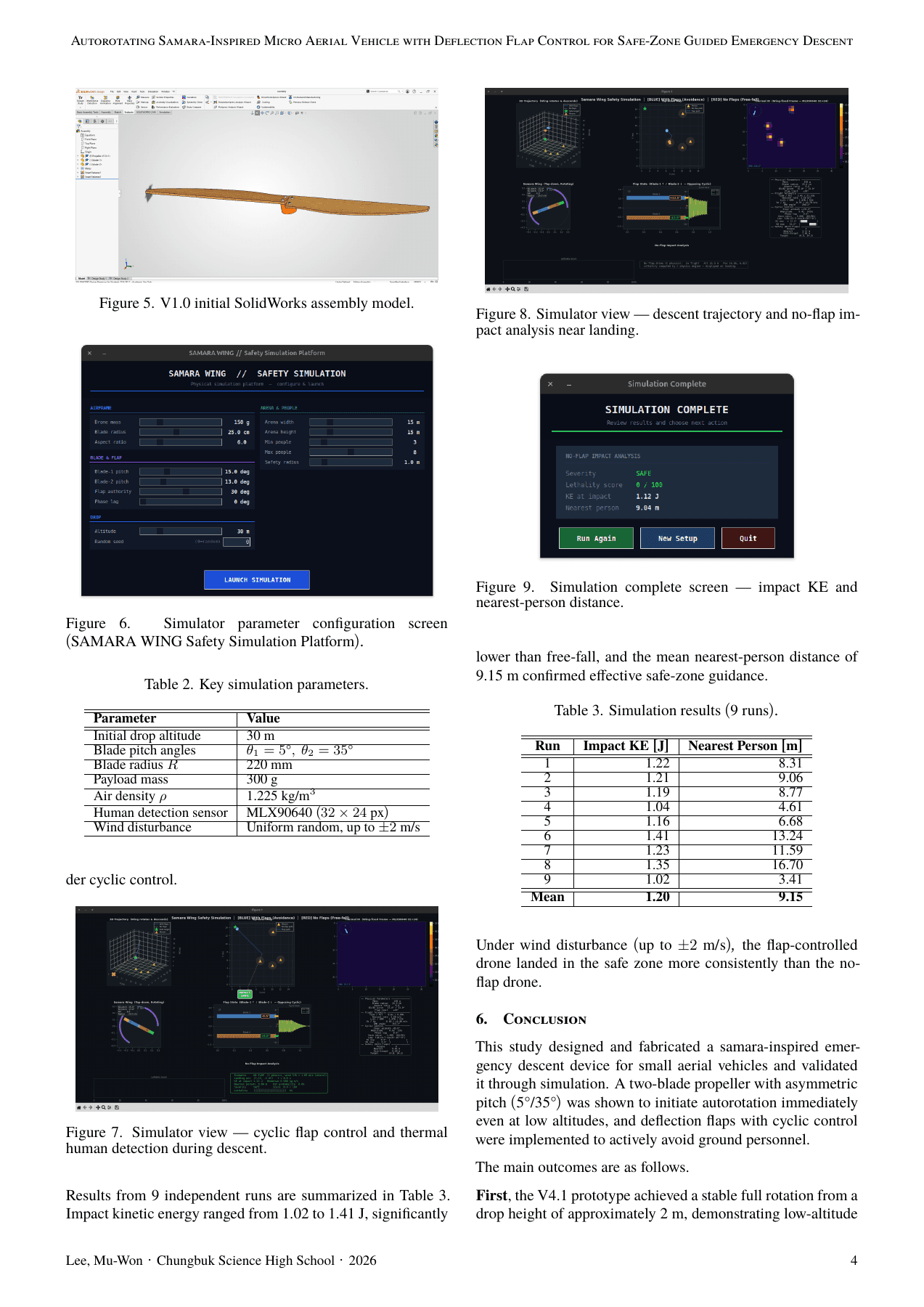
The nine-run simulation uses a 30 m initial altitude, 220 mm blade radius, 300 g payload, 5°/35° pitch, air density 1.225 kg/m³, and uniform wind disturbances up to ±2 m/s.
The report also describes preliminary drop observations, including a roughly 6 m initial prototype drop and full rotation of V4.1 from roughly 2 m. Those observations do not establish a certified minimum deployment altitude.
Results
Report Table 3 records nine simulated runs: mean impact kinetic energy 1.20 J and mean nearest-person distance 9.15 m. The original result page below preserves the simulator screenshots, conditions, and individual-run table.
These are modeled outcomes, not instrumented real-aircraft impact measurements or validated person-avoidance performance.
| Run | Impact KE (J) | Nearest person (m) |
|---|---|---|
| 1 | 1.22 | 8.31 |
| 2 | 1.21 | 9.06 |
| 3 | 1.19 | 8.77 |
| 4 | 1.04 | 4.61 |
| 5 | 1.16 | 6.68 |
| 6 | 1.41 | 13.24 |
| 7 | 1.23 | 11.59 |
| 8 | 1.35 | 16.70 |
| 9 | 1.02 | 3.41 |
| Reported mean | 1.20 | 9.15 |
Discussion
The engineering contribution connects asymmetric mechanical geometry, cyclic control timing, and a simulation interface. A useful next validation boundary is the gap between modeled flap authority and the physical mechanism.
Limitations
The report identifies passive flap locking, minimum autorotation onset altitude, folding deployment, and real-aircraft drop tests as further work. A thermal view inside a simulator is not evidence of a deployed airborne detection system.
References and resources
The IESBJ report is the primary source for the prototype history, geometry, architecture, and nine-run results.
Project resources
Content checked against the original report and linked implementation where available. Reported simulation or dataset results are distinct from physical validation.